News

Asphalt and Fiberglass are the Most Common Materials Used in Berks

(By Amelia A. Lowe, Courtesy Reading Eagle Company ©2007)

People are thankful for many things in life, one of the most common being a roof over their heads. Although most would agree they are thankful to have one, the roof doesn’t get too much attention — unless, of course, it needs to be replaced.

There are plenty of materials used in roofing out there, but what is used really depends on the pitch of roof. Possibly the most popular roofing material used in this area is the shingle, said Barry Lubas, estimator at Bachman’s Roofing in South Heidelberg Township.

BRIAN BOGERT, supervisor at Bachman’s Roofing, puts shingles on the roof of a Cumru Township home.

Shingles are ideal for homes with a 4/12 pitch. According to www.thisoldhouse.com, the pitch, or angle, of a roof is calculated by “the number of inches it rises vertically for every 12 inches it extends horizontally.” For example, a roof that rises 4 inches for every 12 inches of horizontal run has a 4-in-12 (4/12) pitch (most homes in Berks have at least this pitch).

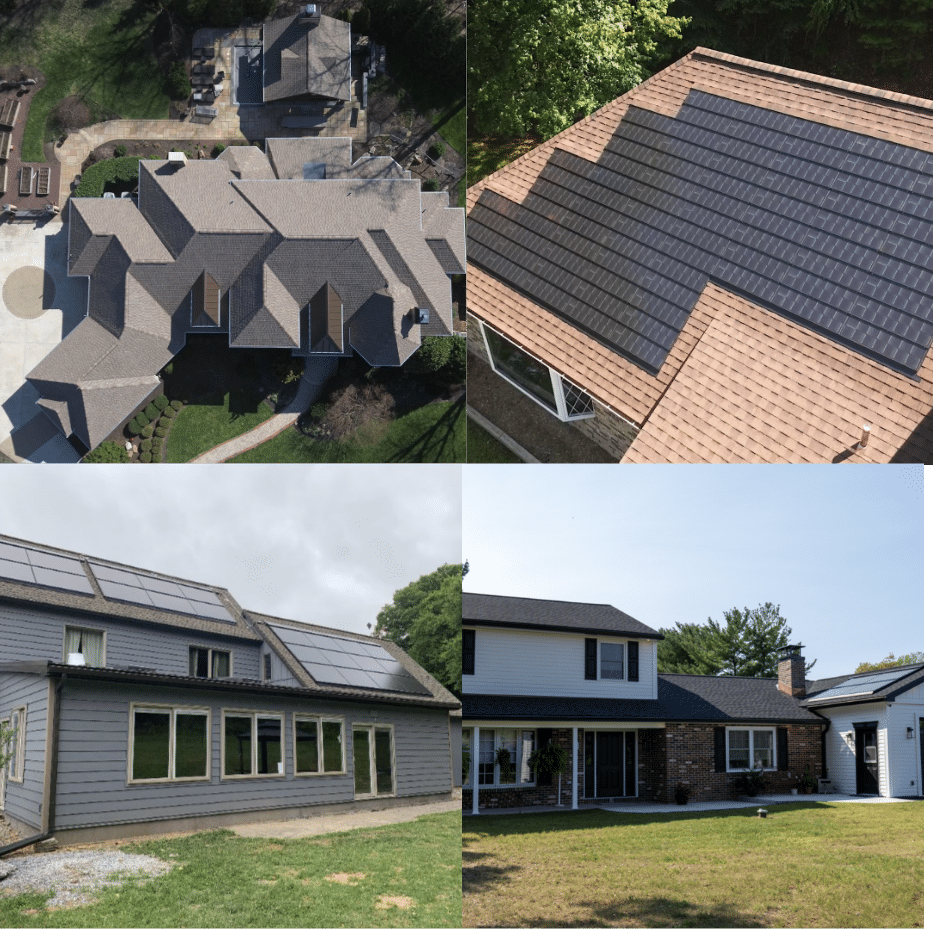
In 80 to 90 percent of roofing jobs they go on in the Berks and surrounding counties, Bachman’s uses an asphalt shingle, which consists of fiberglass matting saturated with asphalt. Granules, which give the shingle color and reflect the sun’s rays, adhere to the asphalt, said Lubas.

Bachman’s uses a Myerstown-based shingle company, Elk Building Products (www.elkcorp.com), for many of their shingling jobs.

A wide variety of color options and styles are available in shingles, explained roofing experts. Customers often go with a “weathered wood” shingle, which is a grayish-brown color. But varieties of grays and browns are always popular.

The cost of having a roof shingled really varies, depending on several factors, including the steepness (pitch) of the roof. According to Lubas, a 30-year shingle can be installed on a roof for anywhere from around $2.25 to $3 per square foot. For a 50-year shingle, which is often used on structures such as churches, banquet halls or firehouses, the cost can range from around $3.50 to $5 per square foot.

Other specialty types of materials used in shingles, such as cedar shake, slate, synthetic slate or steel, are not nearly as common, mainly because they are much more expensive. For instance, slate shingles are about three times more expensive than the fiberglass architectural shingle. These types are mainly used for repairing roofs already made with these materials.

There are several ways to tell if your roof needs to be replaced. If you live in a development, the most obvious sign is if there are neighbors having theirs replaced. Most of the older shingles had about a 25-year life. Also, when shingles start to dry out, crack, buckle or fall off, that is a good sign it is time to replace them, said Lubas. A leaking roof is another sign, he added.

Still not sure? Give us a call today! 610-678-8004

FOR MORE INFO: info@bachmansroofing.com (Posted: August/2007)

Floods May Accompany Rain

(By Mike Urban & Don Spatz, Courtesy Reading Eagle Company ©2003)

A quick thaw, caused by warmer temperatures and rain expected this weekend, could cause flooding in some parts of Berks County, officials said Wednesday.

Most catch basins are blocked with snow and ice, so rain and runoff from melted snow might not be able to reach storm sewers, said Jeffrey L. Squibb, a Reading deputy fire chief and emergency management director. That could cause water to pool on roads and flood homes, he said. "But it’s hard to predict if and where that will happen," he said. "A lot depends on the weather." City workers cannot clear all catch basins but would do so quickly in areas where flooding occurs, he said. City residents could help by shoveling snow away from catch basins and by clearing fire hydrants, he said. Other municipalities also are clearing as many catch basins as possible to prevent flooding. "That’s all we can do, and the rest is up to Mother Nature," said Robert Mc-Nichols Jr., Cumru Township public works superintendent.

The Schuylkill River will rise because of the snow runoff, but it is unlikely to overflow its banks, Squibb said. Wednesday morning the river level was less than 4 feet. The river would have to reach 18 feet before it would spill its banks. When snow melted after the blizzard of 1996 the river crested at 14 1/2 feet but quickly receded, he said. "But that was a lot more snow, and it thawed a lot quicker than it will now," he said.

City crews continue to work round the clock to clear streets, said Charles M. Jones, Reading public works director. Snow hauled from bridge sidewalks and Penn Street is being dumped at Schlegel Park on Huyett Street, near Buttonwood, Sixth and Canal streets, and on a lot at Windsor and Ritter Streets, he said. The city will not put snow into the Schuylkill River because the salt and cinders it contains could pollute the watershed, he said. Snow dumped into a river also could increase the potential for flooding, he said.

Although water seeping into sanitary sewer pipes will increase flow at the city’s wastewater treatment plant, he did not anticipate problems with capacity or flooding. The biggest obstacle for crews has been residents shoveling the plowed snow back onto streets, he said. "Some streets we’ve done three or four times," he said. "As soon as the plow goes by they’re throwing it back."

Local officials said it was too early to determine exactly how much the storm would cost in terms of payroll, equipment and materials. City Managing Director Jeffrey C. White said there is a slim chance to receive some state reimbursement, as the city did after the 1996 blizzard. "If the city is feeling the pinch, I can imagine what the smaller communities are feeling, with their smaller budgets," he said.

In Cumru Township, for example, the 14 street and sewer department workers earned about $30 per hour— their overtime rate — while working 12-hour days Sunday and Monday, which was a holiday, McNichols said. "We’re chipping away at it," said David Y. Bausher, Wyomissing borough manager, who said the cleanup is costing the borough $800 to $1,000 an hour. "But we’re still within the budget at this point."

The heavy snow put a double-whammy on the Reading Parking Authority, which must pay for snow removal and deal with lost revenue from its meters and garages. Metered spaces were still free on Wednesday because too many of the meters were buried, and the garages were free from Sunday through Tuesday, said Lawrence H. Lee, authority executive director. The authority paid workers triple-time on the holiday Monday to dig out the lots and garages, and it must hire a contractor to haul snow piles clogging the surface lots, he said. Authority crews will clean the top floors of the garages, dumping the snow at the Franklin Street Station, he said. The cost will be high, he said.

West Reading on Wednesday began to require owners to remove their cars from certain streets, allowing the borough to clear the snow curb to curb, said Michael D. Hart, public works director. "People want their nice clean streets back," he said.

FOR MORE INFO: info@bachmansroofing.com (Posted: August/2007)

Broiling While Toiling

(By Ben Botkin Reading Eagle, Courtesy Reading Eagle Company ©2002)

Temperatures in the 90s have left laborers in Berks County working hard to maintain productivity — and avoid dehydration and heat exhaustion.

Whether toiling at a construction site or in a drycleaning shop, many workers shrug off the oppressive conditions, saying it’s all part of the job.

While outdoor workers are used to the heat, they still take precautions, said Michael Sprangers of Bedminster, Bucks County, the safety representative for the workers on the bypass project. In his job, Sprangers ensures that employees avoid dehydration or heat exhaustion. He said employees are told to look out for signs that coworkers may be suffering ill effects from the heat, such as slurred speech or dizziness. "It’s basically, ‘You watch my back and I’ll watch yours,’ " he said.

For roofers, the temperature usually is higher than what the thermometer shows, said Barry J. Lubas, a foreman with Bachman’s Roofing, West Lawn. Temperatures on a roof easily can reach 125 degrees, Lubas said. He said his crews go through plenty of water and sports drinks.

"They just take drinks right up on the roof," Lubas said. "The guys are pretty tough."

FOR MORE INFO: info@bachmansroofing.com (Posted: August/2007)